
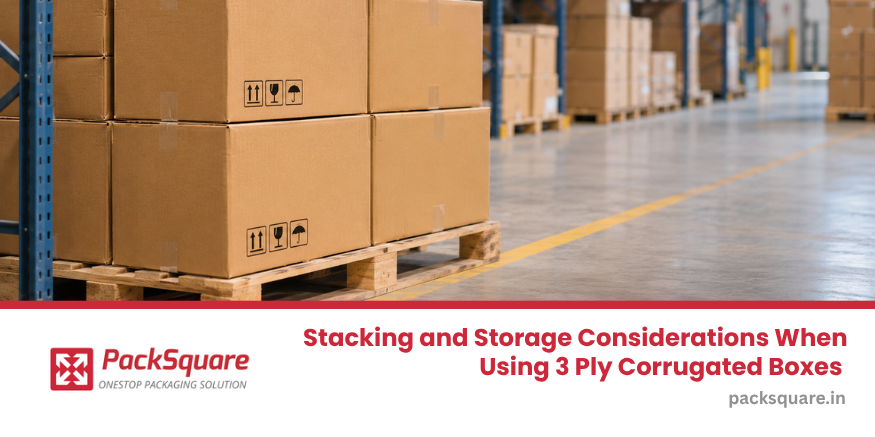
Corrugated boxes play an important role in storing, organising, and transporting products across different industries. However, their performance depends not only on their construction but also on how they are stacked, stored and handled. Excessive weight, moisture exposure, uneven stacking, and improper handling can affect box strength and increase the risk of packaging damage.
Businesses using a 3 ply corrugated box should therefore consider storage conditions throughout the packaging and distribution process. Proper stacking arrangements, balanced load distribution, and suitable warehouse conditions can help maintain box stability during storage and movement. This article explores practical considerations for arranging stacked cartons, managing weight, selecting suitable storage spaces, and handling corrugated packaging. PackSquare supports businesses with corrugated packaging solutions suited to their packaging requirements.
Understanding the Structure of a 3 Ply Corrugated Box
A 3 ply corrugated box consists of three paper layers that work together to provide structure and protection. Its construction includes:
Outer liner: The external paper layer that provides a printing surface and helps protect the contents from everyday handling.
Fluted medium: The wavy layer positioned between the liners. It creates small air spaces that cushion and add to the board’s structural strength.
Inner liner: The paper layer facing the packaged product, which completes the board structure and supports the overall construction.
The fluted medium plays an important role in how the box responds to pressure. Its orientation, condition, and profile can influence vertical compression performance. Board quality, box dimensions, and manufacturing consistency also affect how cartons perform when stacked.
For example, a well-designed box can distribute vertical loads more effectively, while damaged flutes or crushed corners can weaken its ability to support weight. Therefore, businesses should consider the box construction and intended storage conditions when planning their stacking arrangements with a corrugated box manufacturer near me.
Choosing the Right Stacking Arrangement for Corrugated Boxes
How corrugated boxes are arranged can affect stack stability, weight distribution, and warehouse space utilisation. Businesses can choose several stacking methods based on their packaging and storage needs with a packaging box supplier.
Column stacking: Boxes are placed directly on top of one another, with their edges and corners aligned. This arrangement allows vertical loads to transfer through corresponding box walls and corners, supporting compression performance when the cartons are designed for stacking.
Interlocking stacking: Boxes are arranged in alternating directions, similar to a brickwork pattern. This can improve lateral stability in some situations, although it may reduce vertical compression strength if the box walls are no longer aligned.
Pallet stacking: Position cartons within the pallet footprint, avoiding excessive overhang or unsupported edges. Proper placement helps keep the load stable during storage and movement.
Stack alignment: Keep boxes level, with no uneven surfaces or gaps that create concentrated pressure points.
Stack height: Consider box strength, product weight, storage duration, and warehouse conditions before deciding how high to stack cartons.
No single arrangement suits every application. The appropriate method depends on box design, load characteristics, pallet configuration, and storage conditions.
Understanding Load Distribution and Weight Limits
When you stack corrugated boxes, the weight of the upper cartons creates compression pressure on those below. How this weight is distributed can affect stack stability and packaging condition.
Several factors should be considered:
Corner alignment: Keeping box corners vertically aligned helps transfer loads through the stronger vertical sections of the cartons.
Uneven loading: Overhanging boxes, unsupported surfaces, and unevenly distributed contents can create pressure points that increase the risk of crushing.
Product placement: Where appropriate, place heavier products at the bottom of a stack, with lighter cartons above.
Internal movement: Products shifting inside cartons can affect weight balance and create uneven pressure during storage or handling.
Stacking limits: Follow tested stacking or compression limits instead of relying on general weight estimates.
The stacking capacity of a 3 ply corrugated box depends on its board construction, dimensions, contents, environmental conditions, and storage duration. Businesses should consider these factors when planning warehouse arrangements and selecting suitable packaging from a reliable corrugated box manufacturer near you.
Warehouse Conditions That Can Affect Corrugated Box Storage
Warehouse conditions can influence the strength and stability of corrugated packaging, particularly when cartons remain stacked for extended periods. Businesses should monitor the following environmental factors to maintain suitable storage conditions.
Humidity
High moisture levels can weaken paper fibres, reducing the compression strength and stacking performance of corrugated boxes.
Temperature
Significant temperature variations can cause condensation, which may affect stored cartons.
Water exposure
Roof leaks, damp floors, and direct water contact can damage box surfaces and weaken their structure.
Ventilation
Suitable airflow helps manage moisture accumulation and supports a more consistent storage environment.
Floor conditions
Clean, dry, and level surfaces help prevent moisture damage and provide a stable base for stacked cartons.
Storage duration
Cartons stored longer may need regular inspection, especially in warehouses with changing humidity levels.
When storing a 3 ply corrugated box, businesses should avoid placing cartons directly on damp floors or unsuitable surfaces. Using appropriate pallets, monitoring warehouse conditions, and regularly checking packaging can help maintain box condition throughout storage.
Handling and Moving Stacked Corrugated Boxes
Proper handling helps prevent damage to corrugated cartons during warehouse operations and internal distribution. Even well-designed packaging can lose its structural integrity if it is moved or handled incorrectly.
Businesses should follow these practical precautions:
Manual handling: Lift cartons carefully using appropriate techniques. Avoid dragging, throwing, or dropping boxes, as these actions can damage corners and edges.
Pallet handling: Arrange cartons securely within the pallet footprint before moving them to prevent shifting or instability.
Forklift operations: Use appropriate equipment and position forks carefully to avoid striking, puncturing, or compressing cartons.
Moving stacks: Avoid sudden movements, excessive tilting, and transporting unstable loads.
Inspecting cartons: Check for crushed corners, torn surfaces, moisture damage, and other visible signs of deterioration.
Repacking damaged boxes: Replace or repackage cartons when their condition no longer provides adequate support or product protection.
Businesses sourcing packaging from corrugated box manufacturers near me should also consider how their cartons will be handled during storage and distribution. Consistent handling procedures can help maintain packaging condition and reduce avoidable damage.
Maintaining Better Storage Practices for Corrugated Boxes
Maintaining corrugated packaging requires suitable stacking arrangements, balanced loads, appropriate warehouse conditions, correct box dimensions, and careful handling.
Working with a reliable packaging box supplier can also help businesses plan packaging that meets their storage requirements. PackSquare supports businesses with corrugated packaging solutions. Contact PackSquare to discuss your packaging requirements and find suitable options for your products.