
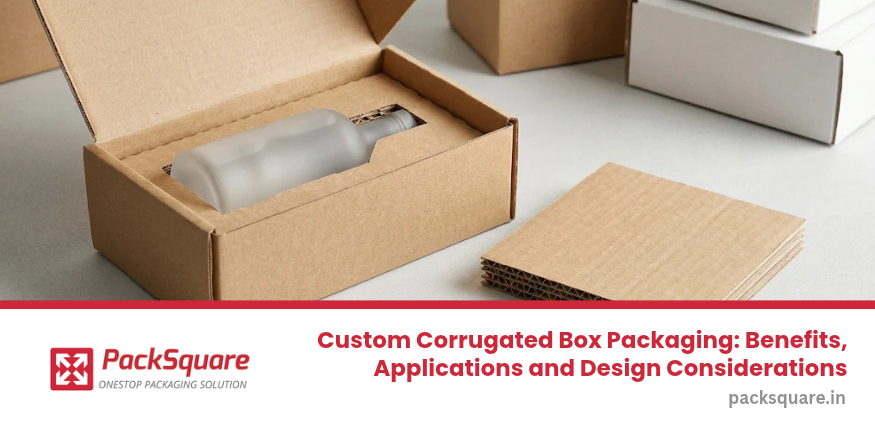
A box that merely holds a product is no longer enough. Packaging must now protect goods through warehousing, handling and long-distance transport, keep shipping costs under control and represent your brand when the customer opens it. Custom corrugated box packaging, such as a sturdy 3 ply corrugated box, does all of this by building the box around your product instead of forcing the product into whatever box is available.
This guide covers what sets custom corrugated boxes apart, the business benefits, how different industries use them, and the design decisions to settle before you place an order.
What Makes Custom Corrugated Boxes Different from Standard Packaging?
Corrugated board is a layered material. A rippled, wave-shaped paper layer called the fluting is sandwiched between two flat sheets: the outer liner and the inner liner. The fluting creates air channels that absorb shock and add rigidity, while the liners provide surface strength and a smooth face for printing.
Standard boxes come in fixed, stock dimensions. They work for general use, but they often leave empty space around the product, which means more movement, more filler and higher shipping volume. Custom corrugated boxes are made to your product’s exact dimensions, with board strength and structure chosen for its weight, fragility and journey.
6 Business Benefits of Using Custom Corrugated Box Packaging
1. Better Product Protection During Transit
The layered structure absorbs impact from drops, vibration and compression. Box strength matters, but so do cushioning and internal partitions, which keep items from knocking against each other. A well-specified box lowers damage rates, returns and replacement costs.
2. Packaging That Fits the Product
A snug fit removes excess void volume and limits movement inside the box. This is especially useful for products with unusual shapes or sizes, where standard packaging wouldn’t fit. Working with local corrugated box manufacturers near you lets businesses customize these dimensions precisely.
3. More Efficient Storage and Shipping
Boxes with consistent, appropriate dimensions stack neatly, making better use of warehouse racks and pallets. Right-sized packaging also improves transport efficiency and can reduce dimensional weight charges, which courier companies calculate based on box volume rather than actual weight.
4. Branding and Product Presentation
Custom printing lets you add logos, colours and brand messaging directly to the box. For e-commerce brands, this shapes the unboxing experience. For retail, it can produce shelf-ready packaging that looks good and still ships well.
5. Material Efficiency and Sustainability
Corrugated board is widely recyclable and can be made from recycled and responsibly sourced fibre. Because custom boxes use only the material the product needs, there is less waste at both the manufacturing and disposal stages.
6. Flexibility Across Different Business Requirements
You can choose sizes, board grades and box styles to suit each product line, from lightweight options to a durable 3-ply corrugated box. Custom corrugated box packaging works for both small batches and bulk orders, and it can be adapted when your range changes.
Where Are Custom Corrugated Boxes Used? Industry-Wise Applications
E-commerce and Retail
Online orders face repeated handling, sorting and last-mile delivery. Shipping boxes need to survive this while also looking presentable on arrival. Many retailers use branded delivery boxes that double as marketing.
Electronics and Electrical Equipment
Electronic components are sensitive to shock and static-related damage. Boxes are usually built around the product’s exact dimensions, with partitions, inserts and cushioning holding each item in place.
Food and Beverage
Packaged food, beverages and dry goods need boxes that handle storage and distribution loads. Where packaging may contact food, specify suitable food-safe materials and liners.
Pharmaceuticals and Healthcare
Secondary packaging for medicines and healthcare products must keep multiple items organised and clearly labelled. Boxes often include dividers and need consistent, clean printing for batch and handling information.
Automotive and Industrial Products
Spare parts, tools and machinery components are heavy and often have sharp or irregular edges. Heavy-duty board or a reinforced 3-ply corrugated box with dividers prevents parts from shifting and damaging one another or the box itself.
What Information Should You Share with a Corrugated Box Manufacturer?
Before placing an order for custom corrugated box packaging, provide the manufacturer with accurate product and packaging requirements. These details help determine the right box dimensions, board strength, construction and printing specifications. Sharing the following information can also make quotation and production planning more straightforward.
1. Product Dimensions and Weight
Start by providing the product’s length, width, height and overall weight. These measurements help the manufacturer determine the box’s internal dimensions and how much space is needed for protective inserts. If the product has an unusual shape, include measurements of its widest and tallest points. Remember to account for additional space required for cushioning materials.
2. Order Quantity and Frequency
Specify how many boxes you need for the initial order and whether you expect to reorder regularly. Manufacturing quantities can influence material procurement, production planning and per-unit pricing. If your business has seasonal demand or fluctuating order volumes, share these details to help the manufacturer plan accordingly.
3. Product Fragility and Protection Requirements
Explain whether the product is fragile, sensitive to pressure, prone to scratches or vulnerable to movement during transit. Glassware, electronics and delicate components may require additional cushioning, dividers or customised inserts. The manufacturer can use this information to recommend suitable board construction and internal packaging arrangements.
4. Storage and Transportation Conditions
Where and how will the boxes be stored and transported? Consider factors such as warehouse humidity, stacking height, long-distance shipping, repeated handling and moisture exposure. Boxes travelling through multiple distribution centres may need stronger construction than those used for short-distance deliveries.
5. Printing and Branding Requirements
If you want branded packaging, share your logo, artwork, brand colours and preferred printing requirements. Also clarify whether the design needs product information, barcodes, handling instructions or regulatory details. This allows the manufacturer to assess suitable printing methods and ensure the artwork fits the available surface area.
6. Delivery Schedule and Special Requirements
Mention your expected delivery date, order frequency and any production deadlines. Also specify whether the boxes need to support particular stacking arrangements, pallet dimensions or automated packing processes. These details can influence the final box design and manufacturing schedule.
The more accurately you communicate your requirements, the easier it becomes to develop packaging that fits your product, protects it during distribution and supports your business operations. Ask for a sample before approving a bulk order so you can check the dimensions, material strength and overall fit.
Common Mistakes to Avoid When Ordering Custom Corrugated Boxes
Choosing on price alone. The cheapest box costs more if products arrive damaged.
Using incorrect dimensions. Always confirm internal measurements, including inserts.
Overlooking stacking and transport conditions. Boxes at the bottom of a pallet carry the load.
Selecting inadequate board strength. Match the board to the product weight.
Ignoring internal cushioning. Fragile items need partitions or inserts, not just a strong outer box.
Ordering in bulk without a sample. Test a sample first to catch fit and strength problems early.
How to Evaluate a Corrugated Packaging Supplier
Searching for corrugated box manufacturers near you is a sensible starting point, since proximity to local corrugated box manufacturers near you can shorten lead times and make sample approval easier. Beyond location, look at:
Experience across different product categories and packaging needs.
Range of custom sizes, board grades and box styles.
Printing and manufacturing capabilities.
Quality checks and consistency across bulk orders.
Flexibility to support changing production and delivery schedules.
Good corrugated box packaging suppliers will ask about your product’s weight, fragility and shipping route before recommending a specification. That is a good sign.
Choose Packaging That Works for Your Product and Business
Effective corrugated packaging comes from getting four things right together: dimensions, board strength, structural design and printing. Before choosing a solution, assess your product’s weight, fragility and distribution route, then match the specification to those needs.
Ready to find the right fit? Explore custom corrugated packaging solutions from PackSquare and get packaging built around your product.